
Negotiating consent for treatment course for Dental Practitioners


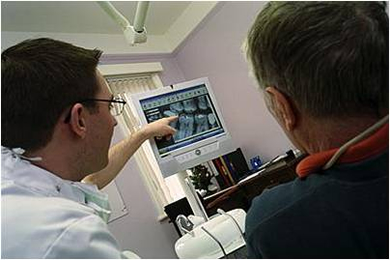



Consent for treatment is a legal requirement involving a detailed explanation of the diagnosis and treatment options. Practitioners must be able to negotiate consent according to the guidance issued by the General Dental Council.
Learning objectives
By the end of this session you will be able to:
- describe best practice in obtaining consent to treatment
- explain why 'information', 'capacity' and 'voluntariness' are key concepts, and how they can be applied
- list the patient communication methods used by practitioners
- describe the key information that should be included on a consent form
- explain the risk of not seeking consent and embarking on complex treatment immediately
Patients have a right to determine what happens to their body. Patients are autonomous individuals and that right must be respected by healthcare professionals.
Before commencing this session you should:
- have completed the e-Den session 1 Patient assessment/Good practice/An introduction to consent
- be familiar with the General Dental Council Standards relating to consent, and the Department of Health 'Reference Guide to Consent for Examination and Treatment'
Stephen is a full time dento-legal adviser for Dental Protection Ltd. He is also a Specialist in Oral Surgery. He qualified in 1984 and worked in fulltime hospital practice until 1989. Between 1989 and 2000, he worked part-time in the Oral and Maxillofacial Unit in Oxford. He had his own practice which he started in 1991, which was a mixture of general and referral practice. He obtained a Masters degree in Medical Law in 2005.
Stephen is also part of the Module Editorial Team at e-Den, and is the Module Editor for Module 10 Communication, and Module 11 Professionalism.



- Values and Attitudes in Practice course for Oral H...
- Posted By eIntegrity Healthcare e-Learning
- Posted Date: 2024-04-17
- Location:Online
- This session explores values, beliefs, prejudice and stereotyping. It encourages reflection on how t...
- Introduction to the Medical/Clinical Leadership Co...
- Posted By eIntegrity Healthcare e-Learning
- Posted Date: 2024-04-17
- Location:Online
- This session provides an overview of the Medical/Clinical Leadership Competency Framework (MLCF/CLCF...
- Introduction to Leadership and LeAD course for Ora...
- Posted By eIntegrity Healthcare e-Learning
- Posted Date: 2024-04-17
- Location:Online
- This session will explore the concepts of leadership in the clinical setting. It also introduces you...
- Holistic Assessment of the Patient for Oral Health...
- Posted By eIntegrity Healthcare e-Learning
- Posted Date: 2024-04-08
- Location:Online
- This session looks at holism, i.e. the integration of physical, psychological and social components ...
- Principles of Screening for Oral Health Practition...
- Posted By eIntegrity Healthcare e-Learning
- Posted Date: 2024-04-08
- Location:Online
- This session outlines the aims of health screening, with a focus on the perspective of patient care....